

industrial design competition
arting project 2020 "heritage"
"[…] Heritage is the designs of our ancestors, their creative achievements, worth remembering and inspiring. There is a focus on sustainability, frugality, the use of natural materials, and living in harmony with the environment. All these things, especially today, need to be reconsidered [...]."
Jacek Graś, industrial designer, president of the People-Innovations-Design Foundation

Idea
The Arting 2020 "Heritage" project was the latest edition of the competition addressing the topic of sustainable design and the first to explore the connections between heritage and contemporary design. Cultural heritage was defined as "a resource of tangible and intangible things, along with the associated spiritual values, historical phenomena, and customs, considered worthy of legal protection."
Arting Project 2020
It consisted of three stages. The first involved expert analyses that helped participants select design themes. Several issues from the history of design in the Polish-Slovak border region of the Beskid Euroregion were identified. Expert articles were also requested on several of these topics, namely: prehistory, highlander culture, Bielsko wool, and cars. The second stage involved the announcement of a sustainable design competition in three categories: heritage, environment, and technology. The third stage involved the presentation of two exhibitions: the first was to present the competition results, and the second, the results of expert research titled "heritage design." Their opening was to be accompanied by a conference, later replaced – due to the coronavirus pandemic – by film materials available on the website projektarting.pl .
The competition entries were judged by a jury composed of Krzysztof Gieleciak, Jacek Graś, Marek Liskiewicz, Marta Sláviková, and Marta Więckowska. The main prize was awarded to Karin Kolesárová. Awards were also won by: Sonia Łuszczyńska in the heritage category; Joanna Włoszczuk, Aneta Witas, Natalia Niewiadomska-Straszewska, Wanda Podbielska, and Maciej Tutak in the environment category; and Anna Szlachta in the technology category. Honorable Mentions were awarded to: Małgorzata Ojczenasz; Magdalena Górska; Joanna Lisiecka, Katarzyna Laskowska, Aliona Kryshtofik, Agata Sargalska, Katarzyna Karpierz, and Wojtek Tężycki.
"[…] A lack of awareness of heritage results in learning crafts from scratch. Regardless of the use of tools and in what areas, we are always dealing with 'works of hands, mind, and heart.' Regardless of the material value of the objects produced, they place human work on a completely different level, valuing it accordingly."
Bogdan Kosak, " On Preserving Heritage "
Arting 2020 "Heritage" Project Exhibition
-
Bioplastic
Vendor:Projekt Arting 2020 "dziedzictwo"Regular price 0,00 złRegular priceUnit price per -
CAMA dream
Vendor:Projekt Arting 2020 "dziedzictwo"Regular price 0,00 złRegular priceUnit price per -
Cieszyn Cookies
Vendor:Projekt Arting 2020 "dziedzictwo"Regular price 0,00 złRegular priceUnit price per -
Ecological high heels
Vendor:Projekt Arting 2020 "dziedzictwo"Regular price 0,00 złRegular priceUnit price per


-
The prehistoric heritage of the Western Beskids - Bogusław Chorąży
moreMankind and the Beskids – this relationship stretches back to prehistoric times. It was never easy – the mountains always posed a communication barrier, surviving another winter here was also challenging, and the soil was not particularly fertile. Yet, the connection between man and the mountains persisted for millennia, leaving its mark on the landscape, with varying degrees of force.
-
From the history of "Bielsko wool" - Piotr Kenig
moreBielsko-Biała, a city of 175,000 inhabitants in southern Poland, lies at the foot of the Beskid Mountains, on the Biała River, which for centuries separated historic Silesia from Lesser Poland. Today, associated primarily with the automotive and electrical industries, until recently it was the second center of Polish textile production after Łódź. It comprises two formerly separate urban centers and 11 rural communes, gradually annexed from 1925 to 1977.
-
The bentwood furniture industry near the Beskids – Piotr Kenig
moreFew industries were as closely linked to ancient Austria as the production of bentwood furniture, which was commonly known internationally as "Viennese furniture." Cieszyn Silesia and the neighboring areas of western Galicia, which remained within the Habsburg Monarchy until 1918, played a significant role in this industry. The vast forest complexes of the Beskid Mountains abounded with the beechwood essential for production.
-
Cars – Zbigniew Michniowski
moreFor a very long time, since the 19th century, Bielsko has been an economic leader on the European map. It was here that one of the first waterworks in Europe was built over 130 years ago, and the power plant built in those pioneering days enabled the construction of a tram line in 1895, also one of the first investments of its kind. Alongside Łódź, Bielsko became a center of the wool industry. Simultaneously, other economic sectors developed, hence Bielsko's later nickname, "The City of a Hundred Industries."
-
Gliders - Zbigniew Michniowski
moreThe history of dreams of flying like birds dates back to ancient times, and the most famous example is the myth of Daedalus and Icarus. In the 12th century, the English philosopher Roger Bacon described the possibilities of human flight in his treatise. Leonardo da Vinci presented significant work in this field in his notes and sketches of design solutions, exploring this creatively and scientifically between 1490 and 1519.
-
On preserving heritage – Bogdan Kosak
moreCraftsmanship is based on heritage and strives for perfection. Any attempt to use craftsmanship to further external goals, ideas, and programs disrupts this balance and results in a loss of the intangible dimension of heritage.
-
Wool – an experiment. Designing with attention to culture
As in previous editions, this time too, we received an invitation to publish as part of the ARTING program. As representatives of the Faculty of Industrial Design, we are happy about this opportunity, especially since the slogan of this year's edition - Heritage - is related to the educational offer of the faculty, implemented in the Alternative Design Studio.
-
Can design change the face of wool?
Wool is a material deeply rooted in Polish culture. As recently as the first half of the 20th century, woolen products were mass-produced in Poland's two main textile centers – Bielsko-Biała and Łódź. Wool "lived" thanks to folk crafts. Kilims, folk costumes, rugs, and hats were Cepelia's exports. Presented and sold in the Cooperative's exclusive boutiques, including the one on New York's famous 5th Ave., they enjoyed great popularity and helped shape Poland's image abroad.
-
Depositories of cultural heritage at the tripoint in the Gorolsko Swoboda Microregion
The Gorolsko Swoboda microregion was established in May 2007 by two non-governmental organizations
from the Czech Republic and Poland and the local government from Slovakia, respectively the Local Circle of the Polish Cultural and Educational Association in Jablunkov, the Branch of the Silesian Highlanders of the Podhale Association and the Oszczadnica commune.


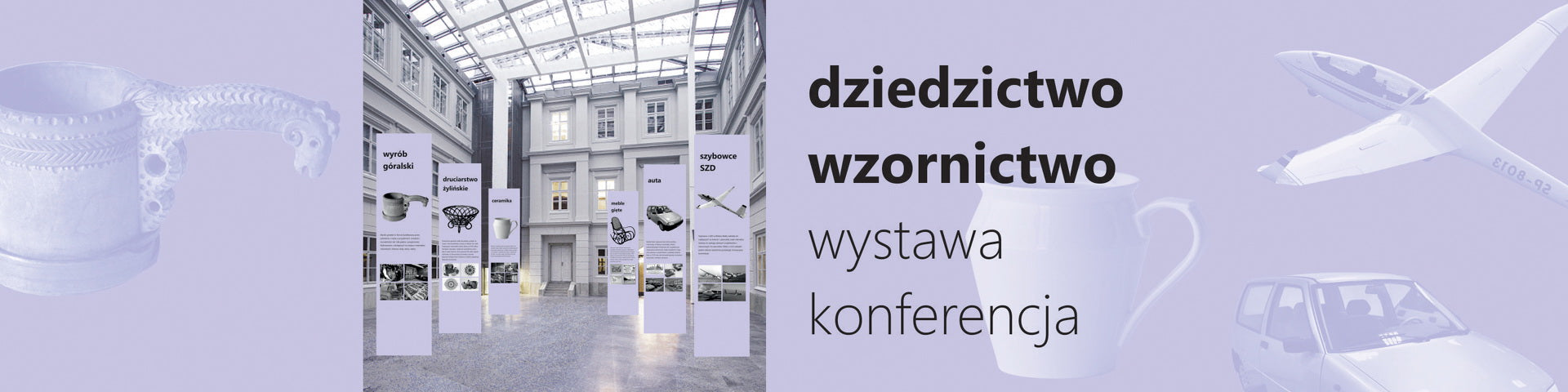

heritage design conference at the Sułkowski castle
The conference "heritage design" is a summary of expert research on the history of design in the Polish-Slovak borderland of the Euroregion Beskidy. It was planned for 25.06.2020 in the castle of the Sułkowski princes, which is the seat of the Historical Museum in Bielsko-Biała. Thanks to the courtesy of the management of this institution, an exhibition of banners illustrating selected historical issues and an exhibition of projects awarded in the Projekt Arting 2020 "Heritage" competition were prepared in the historic courtyard with a glass roof.

heritage design - information brochure
This brochure is an attempt to define the area in which a designer who wants to deal with the issue of heritage in sustainable design will have to move. Several topics from the history of design have been initially selected
the Polish-Slovak border area of the Beskidy Euroregion. An expert article was also asked about several of them, namely: prehistory, highlander culture, Bielsko wool and cars. The collected material is intended to present the topic and provide links and references to further texts, specialists or websites.

industrial design competition
Projekt Arting 2020 "heritage"
Arting 2020 project “heritage” - is the next edition of the competition addressing the theme of sustainable design and the first to explore the relationship between heritage and contemporary design. Cultural heritage is, according to the definition: “a resource of tangible and intangible things together with associated spiritual values, historical and customary phenomena, considered worthy of legal protection.” Heritage is the projects of ancestors, their creative achievements, worth remembering and inspiring. There is thinking about sustainability, economy, use of natural materials, living in harmony with the environment. About all those things that especially today need to be reconsidered.
Partners and sponsors 2022
-
City Hall in Bielsko-Biała
43-300 Bielsko Biała, Plac Ratuszowy 1
www.bielsko-biala.pl -
People-Innovations-Design Foundation
Organizer and lead partner of the project.
-
"Region Beskidy" Association
Project partner:
43-300 Bielsko Biała, ul. View 18/1-3
www. euroregion-beskidy.pl -
Regional development agency Kysuce
Slovak project partner.
Námestie slobody 30, 022 01 Čadca
www.rrakysuce.sk -
Mayor of Bielsko-Biała Jarosław Klimaszewski
Main honorary patronage:
43-300 Bielsko Biała, Plac Ratuszowy 1
www.bielsko-biala.pl -
Historical Museum in Bielsko-Białe
Partner.
43-300 Bielsko-Biała, ul. Hill 16
https://muzeum.bielsko.pl/


Supporting universities

We invite you to see the post-competition exhibition, which was created as part of the micro-project titled “Arting Project” co-financed by the European Regional Development Fund under the Interreg VA Poland-Slovakia Cross-border Cooperation Program 2014-2020 and the state budget.