

Skrzydlaci
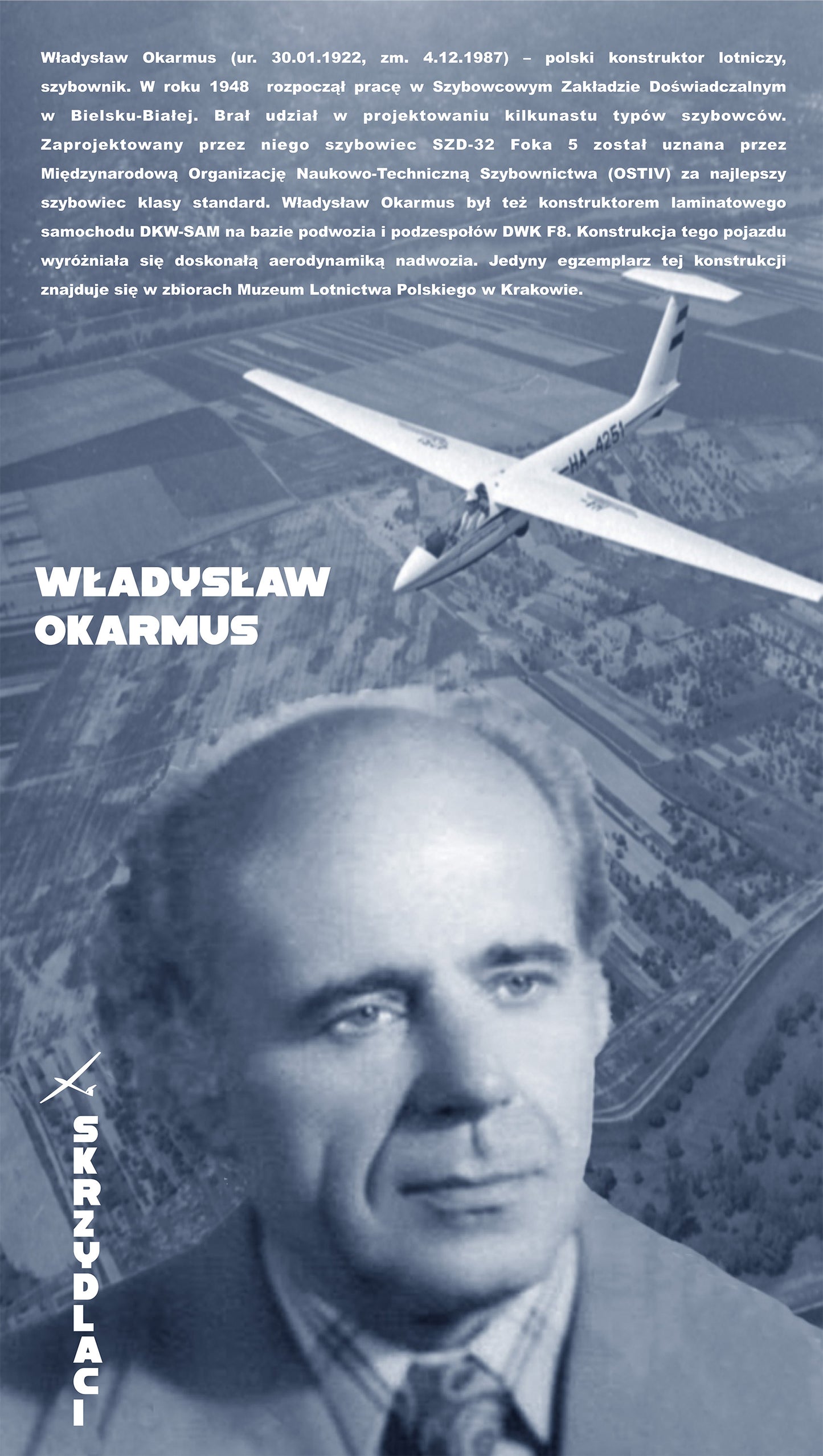
Władysław Okarmus
Władysław Okarmus
He was born on January 30, 1922, in Brody near Kalwaria Zebrzydowska (Kraków Voivodeship), the son of Władysław, a railway switchman, and Józefa (née Krupa). From 1934, he was involved in aircraft modeling. In 1937, he won second place in the district modeling competition in Kraków. That same year, he graduated from high school in Wadowice and began his studies at the State Industrial School in Kraków, which was interrupted by the outbreak of war.
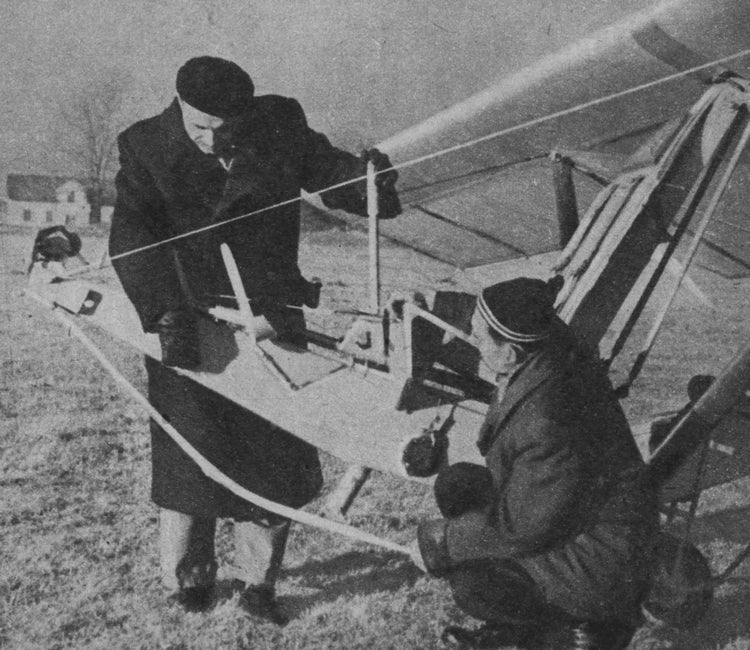
In 1939, he completed a theoretical glider course. In 1938–39, he designed and built an amateur training glider, which he flew himself after the war in 1945. In 1940, he began his studies at the Mechanical Secondary School in Kraków, graduating in 1942. He then worked at the Bata Shoe Factory in Radom, first in the mechanical department, then in the design office. At the factory, he was active in the underground resistance as a member of the Home Army. In July 1944, threatened with exposure, he returned to his hometown of Brody.
From April 1945, he worked at the Befama factory in Bielsko-Biała, but in 1946 he stopped working due to typhus. In 1947, he was employed by the Boiler Industry Association in Kraków. That same year, he completed a glider training course in Bodzów near Kraków, obtaining categories A and B for glider pilots, and subsequently, a third-class glider pilot and a third-class parachutist.
In April 1948, he began working as a design technician at the Gliding Institute (later the Glider Experimental Plant – SZD). He obtained his mechanical engineering diploma with a specialization in aviation externally from the Silesian University of Technology in Gliwice in 1951.
During his thirty-year design career, he designed dozens of prototypes. He participated in the development of the following gliders: the IS-5 Kaczka, SZD-8 Jaskółka, IS-7 Osa, SZD-9 Bocian, SZD-15 Sroka, and, as co-designer of the SZD-14 Jaskółka M with a butterfly tail. He was the lead designer of the Mucha ter 50, SZD-12 Mucha 100, and Mucha 100A gliders (290 in total), the SZD-18 Czajka, and authored the design of the SZD-23 Bocian 2.
He created the Foka family of gliders: the SZD-24 Foka, Foka B, Foka C, Foka 2, Foka 4 and 4A, and the SZD-32 Foka 5, recognized by OSTIV as the best Standard Class glider in 1968. He also designed the SZD-36 Cobra 15 (Standard Class) and SZD-39 Cobra 17 (Open Class) gliders. Polish pilots won championship titles in the World Gliding Championships flying Fokas and Cobras . A total of 640 of these gliders were built and exported to many countries.
He designed the SZD-40X Halny glider, which set numerous records. He also designed the Jantar Standard family of gliders: the SZD-41, SZD-41A, SZD-41B, SZD-48 Jantar Standard 2, SZD-48-1 Jantar Standard 2, and SZD-49 Jantar Standard K. A total of 838 Jantar Standard gliders were built. Of the total, 1,759 gliders of his design were built. Between 1960 and 1980, more than half of the gliders produced at SZD were his own designs.
He held patent No. 80816 ("Retractable landing gear with hatch cover especially for gliders"), used on the Cobra , and was co-author of patents No. 60518 ("Suspension system for a plate-type tailplane") and No. 206401 ("Control system for a control surface in an airframe"), used on the Foca and Cobra .
He published numerous articles in "Technika Lotnicza i Astronautyczna," "Skrzydlata Polska," "Biuletyn Informacyjny ILot, " and " Sailplane and Gliding ." He participated in OSTIV congresses. He was a member of SIMP and a technical advisor to the Aviation Section of the Bielsko-Biała Aeroclub. His hobbies included car design and construction, as well as hang gliding.
He developed a hang glider concept with two staggered wings, creating a slit-like airflow. He valued focused work and independence, presenting his concepts only after they had been maturely developed. He was admired for his factual and succinct statements, packed with essential information. Despite his extensive creative output and professional experience, he remained modest and self-critical.
He received numerous decorations and distinctions, including: the Silver and Gold Cross of Merit (1969), the Knight's Cross of the Order of Polonia Restituta (1976), the Cz. Tański Medal, the Bronze, Silver and Gold Medal of Merit for National Defence (1972), the Medal of the 30th Anniversary of the Polish People's Republic, the State Award (2nd degree) (team), the FAI Paul Tissandier Diploma , the OSTIV Award for the Foka 5 glider (1968), the NOT Award (individual, 1st degree) and the team award (2nd degree), the Blue Wings twice, the Badge of Merit for Sports Aviation (1975), the Badge of Merit for the Polish Air Force.
He married Janina, née Klaja, an economist. They had a daughter, Grażyna , a master's degree in automation engineering and a glider pilot .
He died on December 5, 1987 in Bielsko. He was buried in the municipal cemetery in the Tenement House in Bielsko.
Trivia:
Passion from an early age
- Already as a teenager (from 1934) he was involved in aircraft modeling, and at the age of 15 he won second place in a modeling competition in Kraków.
- At the age of 16–17, he constructed his own training glider, which he flew independently after the war in 1945.
A designer with a mission
- While working at the Bata Shoe Factory in Radom, he not only worked as a designer, but also participated in the underground resistance as a member of the Home Army.
- Between 1960 and 1980, more than half of the gliders produced at SZD were of his design – an impressive influence on Polish gliding.
Modesty and perfectionism
- Despite his enormous professional achievements and numerous awards, he remained modest and self-critical.
- He liked to work focused and independently, and presented his concepts only after they had been maturely developed.
Innovator
- He developed a hang glider concept with two wings arranged in a staggered pattern, which created a slotted airflow—a solution ahead of its time.
- He held several patents related to glider design, including those for retractable landing gear and a control system.
Gliders of the Champions
- Polish pilots won championship titles at the World Gliding Championships in his gliders (Foka, Cobra , Jantar).
- The SZD-32 Foka 5 was recognized by OSTIV as the best standard class glider in 1968.
Aviation family
- His daughter was a master's degree in automation engineering and a glider pilot, continuing the family passion for aviation.