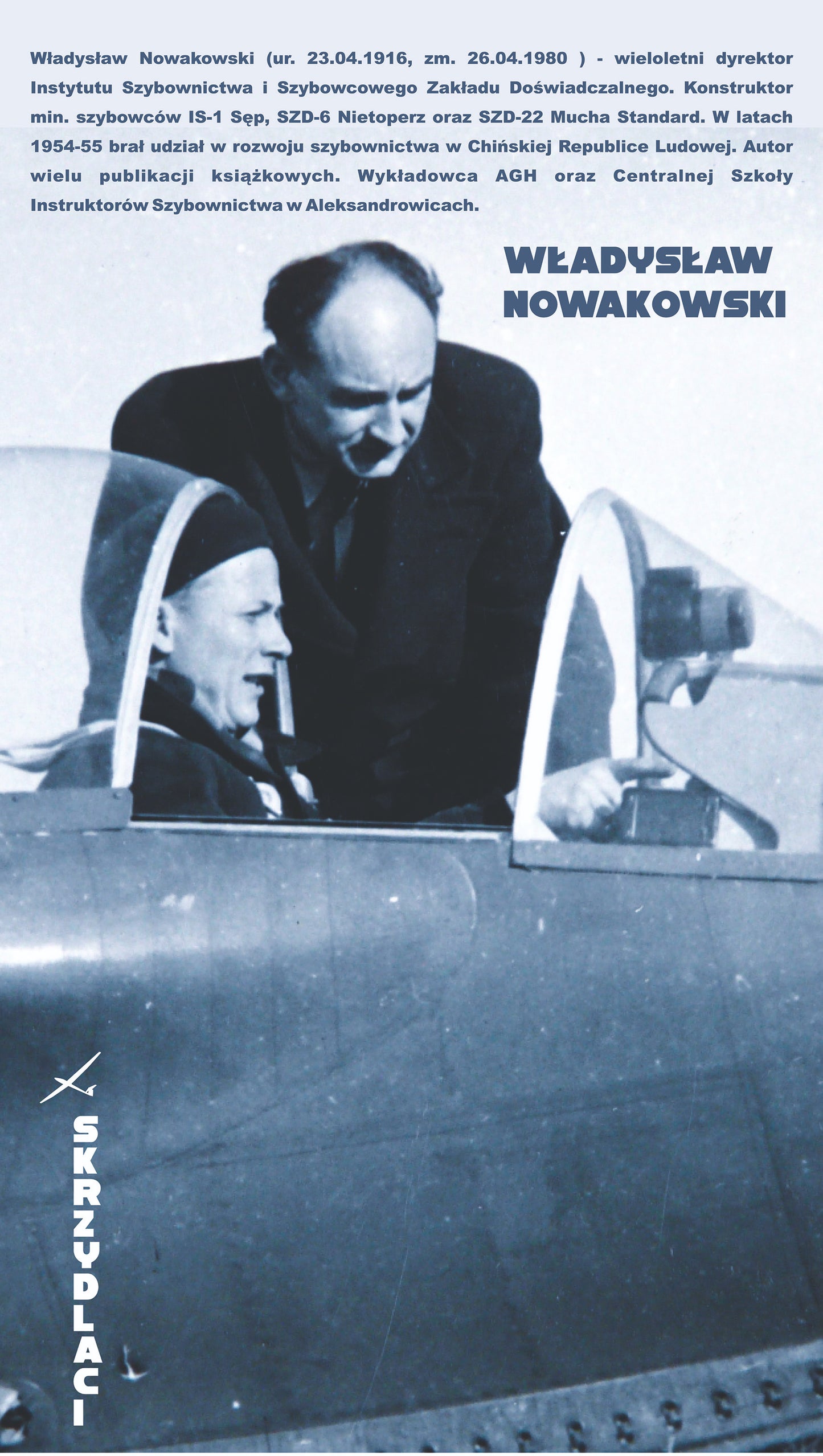


Skrzydlaci
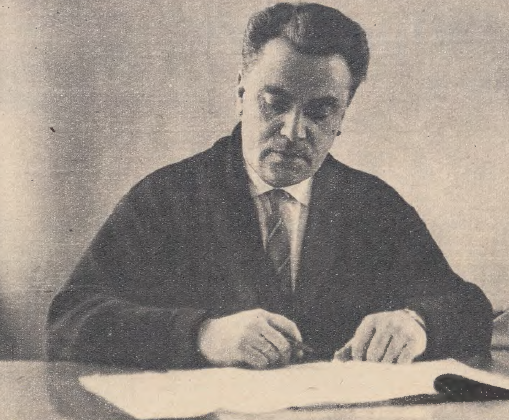
Władysław Nowakowski
Władysław Nowakowski
He was born on April 23, 1916, in Kołaczyce, Jasło County. He attended primary school in Czudec, after which he began his education at the Boys' Gymnasium in Rzeszów.
In 1930, he moved with his parents to Lviv, where he continued his education at the State Secondary School. He graduated from there in 1934 and then began studies at the Faculty of Mechanical Engineering of the Lviv Polytechnic, where his interests in aviation technology, particularly gliders, crystallized.
In 1937–38, he traveled to France and Italy for internships and student training. After completing his studies, he obtained a mechanical engineering diploma in the aviation group after the outbreak of war in 1939.
In 1940–41, he was employed at Glider Works No. 5 of the Osoawiakhim in Lviv, where he gained practical experience as a glider designer. He then moved to Kraków, where, during the occupation, he worked in the design office of the Solvay company. At the end of the war, he was deported to the Płaszów concentration camp .
After liberation, he remained in Kraków for another year, lecturing at the Faculty of Aviation at the AGH University of Science and Technology. He specialized in flight mechanics, while also conducting lectures and design workshops on aircraft engines at the Department of High-Speed Engines.
His passion for gliding led him to move to Bielsko-Biała in 1946, where he began working at the newly established Gliding Institute.
Initially, he headed the IS's research and development department, actively engaging in the creative design of the first post-war gliders, particularly atypical and experimental designs. He was the author of their conceptual designs and computational documentation.
He co-designed the following gliders: the IS-1 Sęp, the IS-2 Mucha, the SZD-6x Nietoperz, the IS-1 Osa, and the SZD-22 Mucha Standard. Until the late 1950s, he consulted on virtually all IS and later SZD glider designs.
At the same time, he established himself as a talented educator. Until 1949, he continued to lecture at polytechnic faculties, commuting to Krakow.
In the years 1948–1951 he lectured on flight mechanics and aerodynamics at the Aviation Secondary School of the State Industrial School in Bielsko-Biała (the secondary school was changed to a technical school in 1952).
He was a co-organizer of the Central School of Glider Instructors of the Universal Organization "Service to Poland" at the airport in Aleksandrowice, where he also later gave lectures.
During this period of his teaching activity, he wrote the textbook "Basic knowledge of the theory of flight", co-authored the work "Gliding" and published a number of articles in the aviation press discussing the aerodynamics of gliders.
In 1948, he was appointed director of the Gliding Institute, later renamed the Gliding Experimental Station. He remained in this position for 29 years, until his retirement in 1977, when, after numerous reorganizations, the facility he headed adopted the name PZL-Bielsko Gliding Experimental and Production Company.
In 1956 he was a member of the Polish team at the World Gliding Championships in Saint Yan .
In 1957–58 he was the co-designer of the SZD-22 Mucha Standard glider, 286 of which were produced and which won the World Gliding Championships in Leszno in 1958.
He was a consultant on aerodynamics during the design of the Foka glider (334 produced in several variants). A further development of the Foka glider was the Cobra , which brought Poland victory in the World Gliding Championships in South Korea . Cerney in 1963
As a consultant to the design office, he created an atmosphere of creative work, inspired and instilled innovative ideas among Bielsko designers.
In the difficult and responsible position of director, he usually conducted extensive and active social and professional activities.
He became particularly close to his home Aeroclub Bielsko-Biała, of which he was president for several terms, receiving the title of honorary president.
In Bielsko-Biała he was also the president of the municipal branch of SIMP.
He had extensive contacts throughout Poland. He was involved in the work of the Aviation League, the Soldier's Friends League, and later the National Defense League and the Aeroclub of the Polish People's Republic.
He collaborated extensively with the Polish People's Republic Aeroclub, developing a deep understanding of its equipment needs. He served on the APRL Council and Gliding Committee.
Throughout his work and activities in Bielsko-Biała, he was a passionate advocate of Polish gliding.
This was reflected, among other things, in his activities on the forum of the International Scientific and Technical Organization of Gliding (OSTIV), where he widely promoted Polish gliding technology, striving for its dominance in the world.
As an outstanding specialist and recognized authority, he spent several months (1954/55) in the People's Republic of China together with Vladimir Humen , where he shared his knowledge and experience in providing assistance in the organization and development of gliding in the People's Republic of China, for which he received the Chinese Star of Friendship.
In July 1952, he was among the winners of the team State Prize for the designers of the Glider Experimental Station (together with J. Niespal , T. Kostia , J. Sandauer and I. Kaniewska) for developing the design of the gliders Mucha, Jastrząb, Nietoperz, Sęp, Kaczka and Jaskółka.
His deteriorating health prevented him from engaging in any wider extra-professional activities in the early 1960s.
Together with the entire staff of the company he managed, he went through various ups and downs of the Polish aviation industry.
However, he always fought tirelessly and with commitment for the Bielsko plant, for preserving the tradition of Polish glider technology, of which he was a co-creator in the post-war years.
Tired of illness, he retired in 1977, after 31 years of work at the Bielsko-Biała construction and production facility, which made a great contribution to Polish gliding, and which he headed as director for 29 years.
He wrote and published two books: "Basic knowledge of the theory of flight" (1957), "Flight mechanics" (1970); he was the co-author of the books: "Gliding" and "Glider pilot's handbook" (1967).
In addition, he was the author of about twenty articles on glider flight mechanics and glider design, published in "Technika Lotnicza", " Schweizer Aero Revue " and "Skrzydlata Polska" in the years 1948–55.
In 1952 he received the State Prize for Technical Progress.
He received numerous state awards for his work.
He died on April 26, 1980 at the age of 64.
Trivia
Pioneer of Polish gliding
- Nowakowski was one of the main founders of the Polish glider industry after World War II. His first design was the IS-1 Sęp, and his last was the SZD-22 Mucha Standard, designed specifically for the 1958 World Championships in Leszno, where the glider won.
International mission in China
- In 1954–1955, he lived in the People's Republic of China, where he co-founded a design office in Chan-Tia-Kou (approximately 100 km from Beijing). Production of Polish-designed gliders, including the "ABC," "Salamandra," and "Bocian," was launched there.
- For his contribution to the development of Chinese gliding, he received the Chinese Star of Friendship – one of the highest awards granted to foreigners by the People's Republic of China.
Creator of aviation knowledge
- He was the author and co-author of many books, including:
- "Basic Knowledge of the Theory of Flight" (1957)
- "Mechanics of Flight" (1970)
- "Gliding" - a manual for glider pilots
- He also published in prestigious magazines such as "Technika Lotnicza", " Schweizer Aero Revue " and "Skrzydlata Polska".
Constructor of unusual gliders
- He was interested in tailless designs and co-created, among others, the SZD-6X Nietoperz, the SZD-13X Wampir and the SZD-20X Wampir 2 – experimental gliders with unusual aerodynamics.
Construction successes
- The SZD-22 Mucha Standard was one of the most successful gliders in Polish history:
- 288 units were produced
- They have been exported to over 20 countries, including the USA, Great Britain, Argentina, Australia, France and Japan.
- He won the World Championships in Leszno in 1958
Educator and mentor
- For many years he lectured on flight mechanics and aerodynamics at technical schools and universities, including the AGH University of Science and Technology in Kraków and Bielsko-Biała.
- He inspired young designers, creating an atmosphere of creative work in the SZD design office.