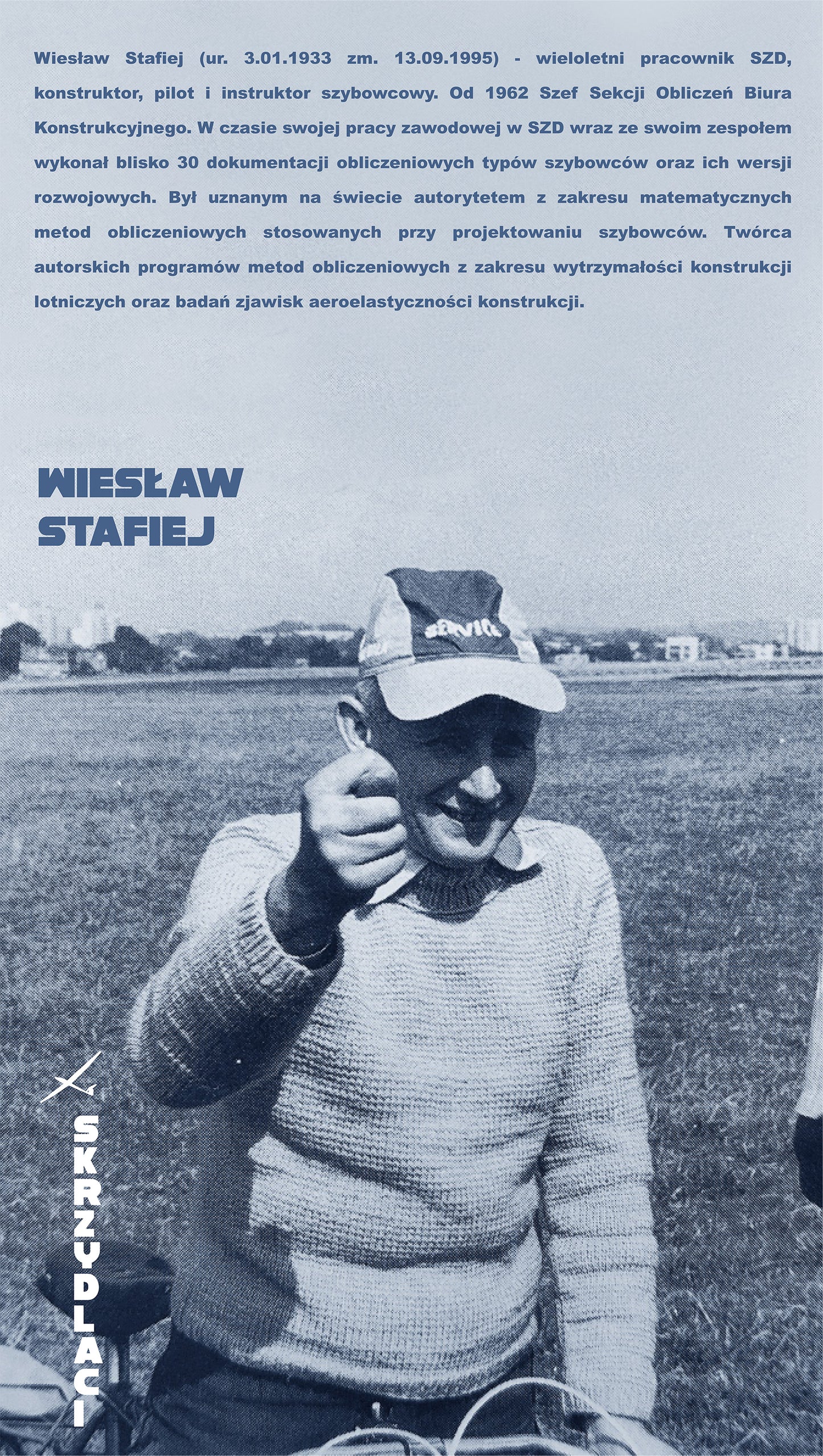


Skrzydlaci
Wiesław Stafiej
Wiesław Stafiej
He was born on January 3, 1933, in Rzeszów. He attended A. Mickiewicz High School in Katowice, where he was a member of the Scouts and co-organized the Aviation League Chapter in 1948. He passed his secondary school leaving examination in 1950. He began his studies at the Faculty of Aviation at the Wrocław University of Science and Technology, where he founded the vocal ensemble "Rewelerzy." At the same time, he completed a degree in choral conducting at the School of Music. After transferring to the Warsaw University of Technology in 1957, he earned a Master of Science in Aeronautical Engineering. He then began working at the Glider Experimental Station in Bielsko-Biała. Initially, he worked as a designer, designing gliders: the high-performance SZD-19X Zefir, the experimental tailless SZD-20X Wampir, and the training SZD-16 Gil. Due to his theoretical interests, he began specializing in calculations, taking over the Calculation Section of the SZD Design Office, established in 1962. After numerous company reorganizations, the section was transformed into the Development and Calculation Department. He, alone and with the team he led, prepared computational documentation for approximately 30 glider types and their development versions, from the SZD-19X Zefir to the SZD-56 Diana. He was the author of numerous calculation methods, including complex orthotropic wooden and composite structures, programming methods for ground static and dynamic tests, the use of in-flight measurements, consideration of aeroelastic phenomena, variable profile geometry, and more. In 1979, he obtained his PhD from the Rzeszów University of Technology, where he contributed for many years to the design of aircraft structures. He had a rich publication record, both scientific and technical, as well as popularization. Together with Eng. Adam Skarbiński wrote the textbook "Design and Construction of Gliders" (1965). In "Przegląd Lotniczy" he published the series "Designing an Amateur Airplane". He wrote a collection of aviation memoirs "Z mewkami w klapie" (With Seagulls in the Flap) ( 1999). He was the author of articles on the theoretical foundations of glider technology, published in "Technika Lotnicza i Astronautyczna" and "Biuletyn Informacyjny ILot " (Information Bulletin ILot), as well as abroad - in "Aero Revue ", technical articles published mainly in "Skrzydlata Polska" and "Magazyn Technologa Przemysłu Lotniczego i Silnikowego" (Magazine of the Technologist of the Aviation and Engine Industry), and many popularizing articles in "Skrzydlata Polska", "Horyzonty Techniki" and other popular science magazines in Poland, as well as in " Sailplane and Gliding " in England. He was the author of the first textbook in Poland, "Gliding" (1978). He participated in numerous national aviation science symposia, where he presented his own research on aerodynamics, flight mechanics, and strength; he also explored topics related to the history of Polish gliding. His fluency in foreign languages, particularly English and German, allowed him to participate in numerous international scientific congresses and symposia. He presented papers at OSTIV congresses in Poland, the USA, Yugoslavia, Australia, and Finland, and represented Poland at the FAI General Conference in India. From 1968, he represented Poland on the OSTIV Expert Council of the FAI International Aeronautical Federation. As an OSTIV representative, he developed and presented on aerodynamics and loading issues, and these studies became the source material for the international OSTIV 71 glider construction regulations, among other things. He participated in the IDAFLIEG and EUROMECH '76 scientific symposia in Germany. He was delegated numerous times by the SZD (Polish Aviation Association) on matters related to glider equipment certification and acquisition in Great Britain, Australia, Finland, France, the Netherlands, and the USA. He was an activist in the SIMP Company Branch and authored numerous lectures, primarily for young people. He organized and led a technical English language course at PZL-Bielsko, focusing on aviation vocabulary, while also developing a script for the course participants. He obtained certification as a translator of technical texts from NOT (English and German). He translated most of the certification documentation for Polish gliders into English. He was a certified appraiser and lecturer at SIMP in the aviation specialty. He began his flight training at the Gliding School in Rzadkowo near Piła in 1951. He was certified as a glider instructor and performed this function on a voluntary basis. His ability to connect with young people allowed him to pass on his skills to several generations of young aviation enthusiasts. From 1960 to 1990, he served as a member of the Board (including secretary) of the Bielsko-Biała Aeroclub. From 1969 to 1974, he was a member of the Main Board and the Gliding Committee of the Polish People's Republic Aeroclub. He participated as a co-organizer in numerous aviation events, primarily in the propaganda department or on the judging panels. From 1969, he lectured on flight mechanics at APRL flight instructor courses. He was a promoter and consultant for amateur aircraft design and hang gliding, particularly in the area of computational engineering. As a reserve captain, he co-organized and created the core curriculum of the Reserve Officers' Club at PZL-Bielsko. He was a trustee of the Metalworkers' Trade Union. He was nonpartisan. Throughout his life he received numerous decorations and awards: State Award - team award, 1st degree, Gold and Silver Cross of Merit, Silver and Bronze Medal "For Merit to the Defence of the Country", Medal of the 30th Anniversary of the Polish People's Republic, Gold Badge of J. Krasicki, 1000th Anniversary Badge, 50th Anniversary Medal of Sports Aviation, Gold and twice Silver Badge "For Merit in the Development of the Katowice Voivodeship", Gold Honorary Badge of SIMP, Award "For Outstanding Technical Achievements" 2nd degree - team (twice, in 1972 for the Foka glider), Team Award of the Mayor of Bielsko-Biała for the development of the Orion and Jantar gliders, "Blue Wings" - team distinction and for the Orion glider and secondly for the Ogar motor glider, Silver Badge "For Merit to the Development of the Machine Industry", Badge of Meritorious Activist of Sports Aviation, Badge with plaque "2 services for APRL", Gold and Silver Badge of Meritorious Activist of LOK, Silver Badge of the Trade Union of Metalworkers, Silver Badge of Meritorious Activist of ZZM, XX- Badge Anniversary of Silesian Sport, OSTI Diploma, FAI Tissandier Diploma . He had a passion for theoretical considerations and insightful solutions to technical problems and their popularization. He enjoyed giving lectures, readings, and talks. He had a strongly developed didactic sense. Thanks to his optimism, sense of humor, and exceptionally helpful disposition, he gained great respect among his colleagues and associates. With a high personal culture, he could be uncompromising in the face of evil. He wrote epigrams and poems, drew and created graphic arts, and played the piano. He was a passionate hiker, skier, and sailor. He cultivated an allotment garden. He was described as a Renaissance man. He was a deeply religious man with a strong sense of inner order. He treated life as a mission. He did not start a family; he cared for his seriously ill mother. He died on November 13, 1995, in Bielsko-Biała and was buried at the Grunwald Cemetery.
Trivia:
- Musical talents – in addition to his career as an aviation engineer, he graduated in choral conducting and founded a vocal ensemble called Rewelowcy while studying at the Wrocław University of Science and Technology.
- Artistic versatility – he wrote epigrams and poems, drew, practiced graphic arts, and played the piano. He combined technology with culture and art.
- A passion for teaching , he conducted lectures, talks, technical English classes, and courses for flight instructors. He possessed a highly developed teaching flair.
- A pioneer of hang gliding in Poland – he was the author of the first Polish textbook, “Gliding” (1978), which makes him one of the pioneers of this field in the country.
- Language skills – he was fluent in English and German, which enabled him to participate in international congresses and translate technical documentation of gliders.
- A Renaissance man – described as such by his colleagues due to his wide-ranging interests: technical, artistic, sports (skiing, sailing, tourism), and gardening.