
Skrzydlaci
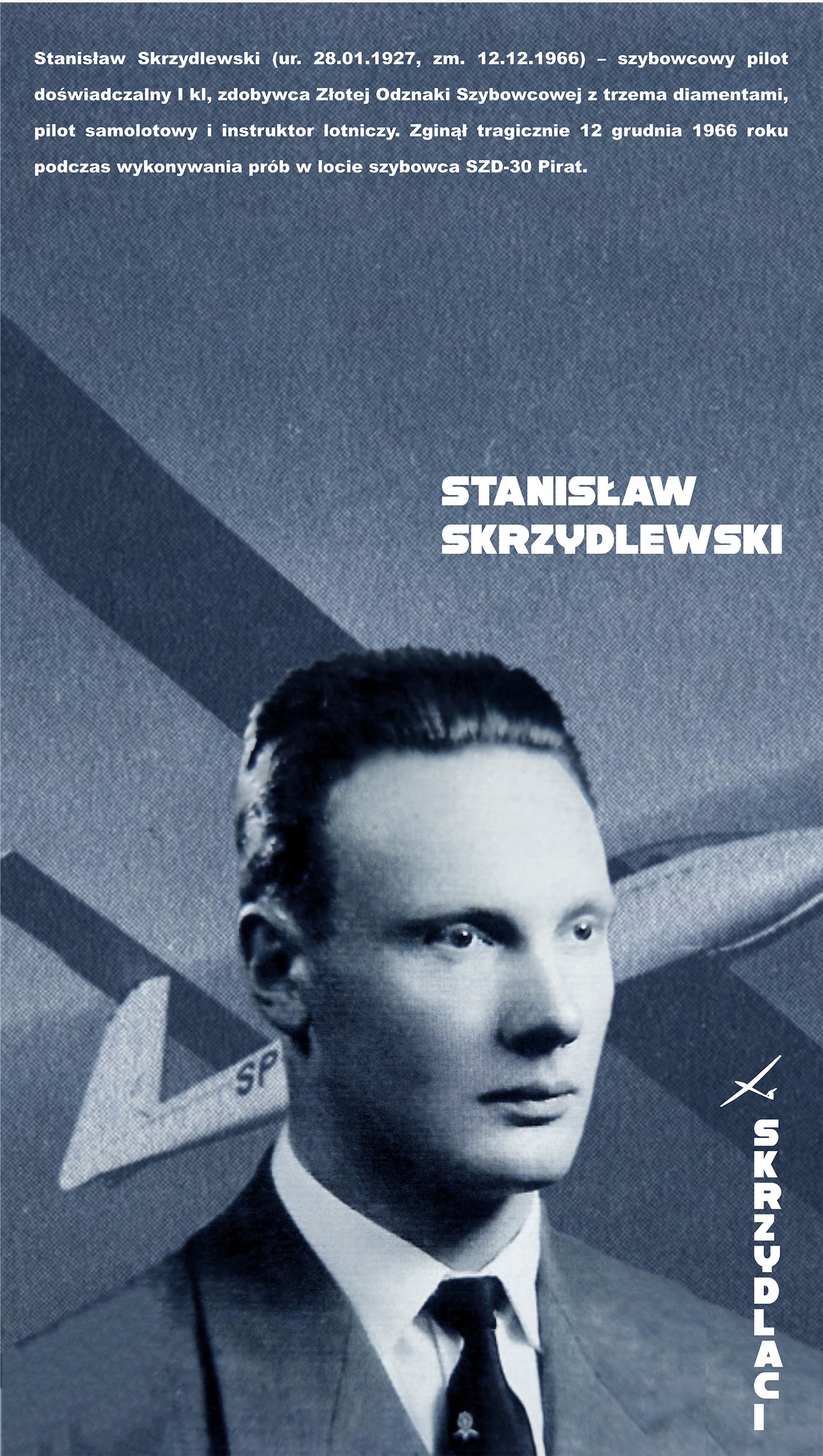
Stanisław Skrzydlewski
Stanisław Skrzydlewski
He was born on January 28, 1927, in Unisław (Pomeranian Voivodeship). From his boyhood, he was interested in aviation, particularly through aviation books. Reading the clandestine edition of Arkady Fiedler's "303 Squadron" was a profound experience for him.
In August 1945, he began flying lessons at the Grodziec Gliding Training Center near Sosnowiec, where he earned a category A glider pilot license. From November 1945, he was a member of the Silesian Aeroclub in Katowice. In July 1946, in Goleszów, he earned a category B glider pilot license, and in August 1947, in Katowice, a category C glider pilot license. After obtaining his secondary school leaving certificate in 1947, he began studies at the Faculty of Mechanical Engineering of the Gliwice University of Technology, graduating in 1951 with a master's degree in mechanical engineering.
In 1948 he received the Silver Gliding Badge (No. 251), and in 1950 the Gold Gliding Badge (No. 10). In 1951 he competed in the 8th National Gliding Competition in Inowrocław (10th place), achieving a height difference of 6,380 m (without an oxygen mask), and in 1952 in the 9th National Gliding Competition in Kobylnica near Poznań (12th place), setting a homologated feat over a 100 km route at a speed of 91.2 km/h.
In 1953, he finished eighth in the Polish Gliding Championships in Leszno. He was awarded the Gold Gliding Badge with three diamonds, the third pilot in Poland and 14th in the world. He became a member of the national gliding team. He completed a 300 km (35 mph) triangle flight.
In 1954, he took fifth place in the "Winged Poland" Year-Round Gliding Competition and 16th place in the International Gliding Competition in Leszno. He completed numerous speed, destination, and destination-return flights.
From January 1955, he worked as a test pilot at the Glider Experimental Station (SZD) in Bielsko-Biała. He transferred to the Bielsko-Biała Aeroclub. In 1955, he finished fifth in the Polish Championships in the two-seater glider category (Bocian), earning him the title of Master of Sports.
He led a glider expedition to India, where a glider demonstration was held with the participation of Indian Prime Minister J. Nehru on November 23, 1955. After a flight in the Bocian glider piloted by Wanda Szemplińska, the glider was handed over to Prime Minister Nehru by the Polish Ambassador.
In 1956, he finished fifth in the Polish Championships. He became a member of the Restitution Commission of the Aeroclub of the Republic of Poland, and in December 1956, vice-president of the Aeroclub of the Polish People's Republic for the years 1957–1959. He represented the Polish Aeroclub on the FAI Gliding Commission, thanks to which Poland was awarded the right to host the World Gliding Championships in Leszno in 1958.
In 1957, he finished 30th in the Polish Championships. In 1962, he competed in the British Championships, treating his participation as a social event. He traveled abroad on gliding equipment business: to Great Britain (1960, 1962), the Netherlands (1961), and Tunisia (1964).
As head of the SZD flight test department, he introduced modern measurement methods: multi-channel oscillographs, tape-recorded commentary, on-board cameras, and radio communications. He developed flight measurement methodologies and drew accurate conclusions useful in glider design.
He began conducting state control tests at the SZD, previously conducted by the Institute of Aviation in Warsaw. He collaborated with the Department of Flight Mechanics at the Warsaw University of Technology and the Flight Research Department at the Institute of Aviation on aeroelasticity and flutter studies.
He performed the first flights on glider prototypes:
- SZD-15 Magpie (1956),
- SZD-19X Zefir-1 (1958),
- SZD-25 Nov (1960),
- Zephyr-2 (1960),
- SZD-21 Kobuz-1 (1961),
- SZD-21-2AY Kobuz-2 (1962),
- SZD-21 Kobuz-3 (1964),
- SZD-29 Zefir-3 (1965),
- SZD-32 Foka-5 (1966).
He flew almost every glider used in Poland and a dozen or so foreign ones. He was an authority in the test pilot profession, highly regarded by the SZD management.
He was an active member of the Polish People's Republic Aeroclub Gliding Committee, the Polish Air Force Academy (APRL) Audit Committee, the national gliding team, and the board of the Silesian Aeroclub. He authored numerous theoretical works on gliding and co-authored the book "Przeloty glidowcowe" (Glider Flights) (published in Poland, Bulgaria, and the USSR).
He held a First Class glider test pilot certificate and a First Class airplane pilot certificate. He had a total of 2,134 flight hours (1,612 in gliders, 522 in airplanes). He was awarded the Silver Cross of Merit and the Meritorious Sports Aviation Activist badge.
He tragically died on December 12, 1966, during flight tests of an SZD-30 Pirat glider in Aleksandrowice. He was in a spin and failed to recover due to jammed ailerons. A magnetic tape of the flight survived, but not the cause.
He is survived by his wife, Stefania née Balcar (an educator with a Master of Science in Agriculture), and daughters: Mirosława (a pharmacist) and Joanna (an anesthesiologist). He is buried in Katowice at the cemetery on Francuska Street. A street in the Polish Wings housing estate in Bielsko-Biała is named after him, and there is also a boulder with a commemorative plaque.
Trivia
Pioneer of modern glider research
- He was the first in Poland to use multi-channel oscillographs to record glider flight parameters – despite the lack of a permanent source of electrical power on board.
- He recorded the flight commentary on a miniature tape recorder , a technique used mainly in astronautics at the time.
- He introduced an on- board camera and radio communication into the flight tests , which significantly increased the precision of the analyses.
International ambassador of Polish gliding
- His activities contributed to the organisation of the World Gliding Championships in Leszno in 1958 , which was a huge success for the Aeroclub of the Polish People's Republic.
Pilot of the first flights
- He performed the first flights on prototypes of many Polish gliders, including the SZD-15 Sroka, SZD-19X Zefir-1, SZD-25 Lis, SZD-21 Kobuz-1, SZD-29 Zefir-3 and SZD-32 Foka-5.
- He flew almost all gliders used in Poland and several foreign ones.
Author and theoretician
- Co-author of the book "Przeloty glidowcowe" published in Poland, Bulgaria and the USSR - one of the first publications systematizing knowledge about sports gliding.
Awards and achievements
- He held the Golden Glider Badge with three diamonds – the third in Poland and the 14th in the world.
- He flew 2,134 hours , of which 1,612 in gliders and 522 in airplanes.
- He was awarded the Silver Cross of Merit and the badge of Meritorious Sports Aviation Activist .
Tragic death
- He died on December 12, 1966, during tests of the SZD-30 Pirat glider. The cause was a jammed aileron mechanism , which prevented the glider from recovering from a spin.
- A magnetic tape recording of the flight was preserved, but it did not contain a recording of the cause of the accident.