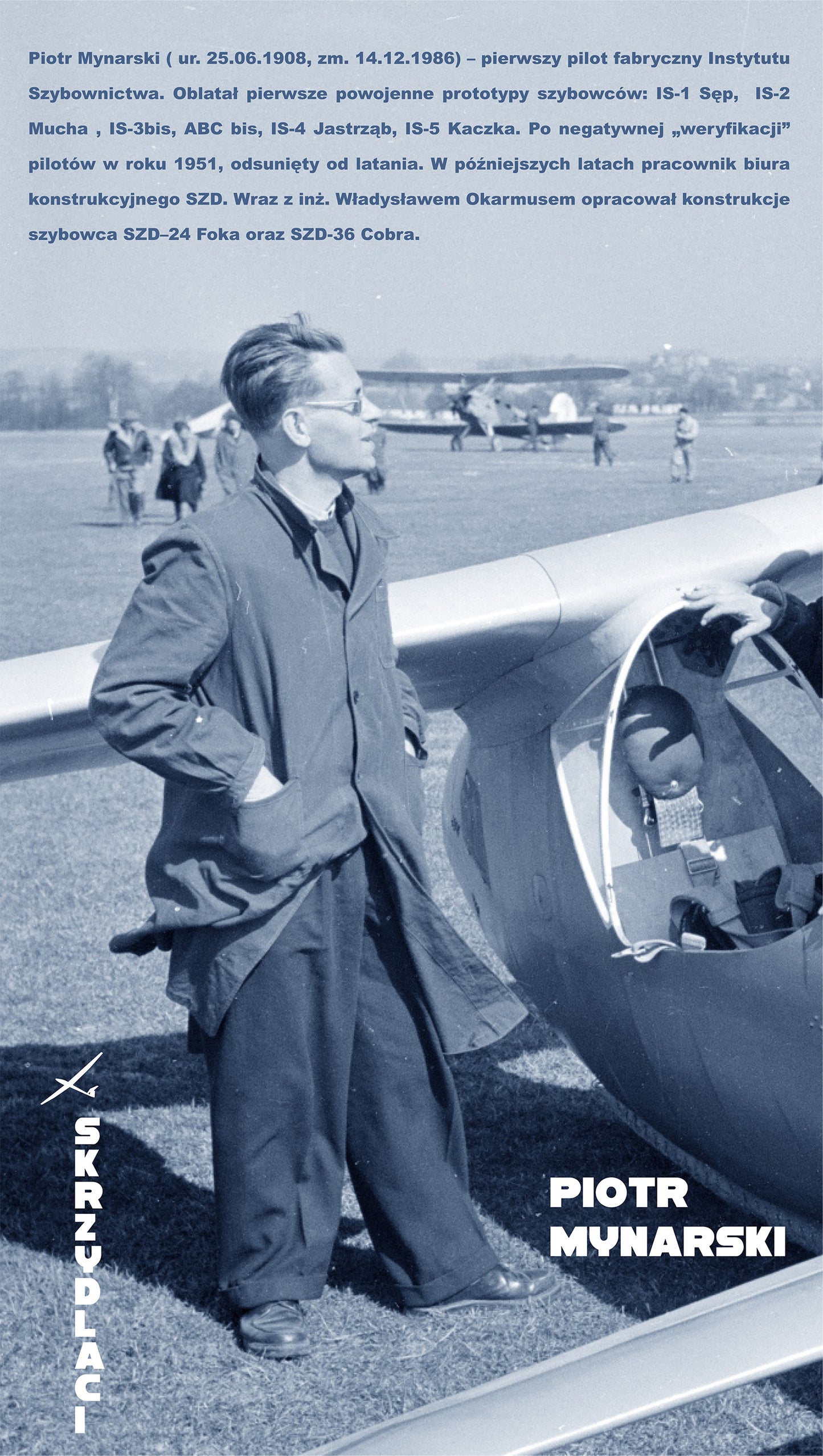


Skrzydlaci
Piotr Mynarski
Piotr Mynarski
He was born on June 25, 1908 in Stara Wieś near Oświęcim in the family of Jan (a farmer) and Teresa.
In 1928 he passed his secondary school leaving examination at the Adam Asnyk High School in Biała Krakowska.
In the years 1928–1929 he did his military service at the Reserve Officer Cadet School, obtaining the rank of reserve second lieutenant.
In the autumn of 1929, he began his studies at the Faculty of Mechanical Engineering of the Lviv Polytechnic and began working on the construction of gliders in the workshops of the Aviation Association of Students of the Lviv Polytechnic.
In 1929 he was a co-founder of the Lviv Academic Aeroclub.
He took part in glider expeditions to Bezmiechowa near Lesko in the years 1929–1932.
In November 1930, he was the second in Poland to obtain category A glider pilot certification, and in June 1932 he obtained category C.
In 1932 he interrupted his studies.
From May 1932 to May 1936 he worked as a glider instructor at the Gliding School of the Lviv Aeroclub in Bezmiechowa.
On September 18, 1932, he made a flight in a Czajka glider lasting 7 hours and 7 minutes,
and in July 1933, the first thermal flight in Poland over flat terrain, staying in the air on a Komar glider for 5 hours and 52 minutes.
He set the following national gliding records:
- July 19, 1933 – open-air flight record of 84.2 km on the CW-5bis/33 glider on the Lviv – Brzeżany route
- October 30, 1933 – flight endurance record in the SG-3/34 glider of 11 hours and 52 minutes with a night landing
- April 11, 1934 – flight endurance record in a two-seater glider CW-IV (together with Alfred Zaliński) of 4 hours and 23 minutes
- October 5, 1934 – CW-IV record of 9 hours and 7 minutes
- May 1, 1934 – record outward and return flight from Bezmiechowa with a length of 15.8 km
In 1935, he was the first in Poland to receive the Silver Glider Badge (category D), international number 179.
On November 9, 1935, he achieved a great feat in the Wrona training glider – he stayed in the air for 4 hours and 7 minutes.
From 1933 he performed experimental flights for the Institute of Gliding Technology in Lviv.
In July 1933 he completed a course in towed glider flights in Lviv.
On August 1–15, 1933, as a member of the Scout glider team, he took part in the IV International Scout Jamboree in Gödöllö near Budapest, where he gave a glider flight demonstration in an SG-28 during a parade of Scouts from all over the world,
and to the Hungarians he demonstrated a flight over a flat area 65 km long.
In May 1936 he took part in the ISTUS (International Gliding Studies Commission) Gliding Competition in Budapest, flying a Komar glider.
From April 1936 to September 1939 he was the head of the High-Performance Gliding School in Bezmiechowa and at the same time the head of its workshops.
In 1937, at the International Gliding Competition in Rhön-Wasserkuppe , Germany (recognized as the 1st World Gliding Championship), he took 10th place and set a distance record in a PWS-101 glider, flying 351 km from Wasserkuppe to Hamburg.
In 1938 he obtained a tourist pilot license at the Lviv Aeroclub.
In 1940, he resumed his studies, entering the fourth year of the Lviv Polytechnic Institute (as the Lviv Polytechnic was then called), which he interrupted after a year when the Germans entered Lviv and closed down the university.
From September 1941 to August 1943 he worked as a lecturer-tractor instructor at the Agricultural School in Dublany near Lviv.
Arrested in August 1943 in a street raid in Lviv, he was imprisoned by the Germans for six months.
After the Soviets re-entered Lviv, from August 1944 to April 1945 he worked as a technician in the design office of the Motopoyezd No. 4 enterprise in Lviv.
In the autumn of 1945 he evacuated from Lviv and took up work in the Rozbark mine in Bytom.
From January 1, 1946 to April 30, 1946, he was the head of the Żar High-Performance Gliding School in Międzybrodzie Żywieckie,
and from 1 May 1946, a test pilot at the Gliding Institute in Bielsko-Biała (renamed the Gliding Experimental Station – SZD in 1948).
As a test pilot, he flew prototype gliders:
- transitional IS-A Salamandra 47 (1946)
- training IS-B Komar 48 (1949)
- high-performance IS-1 Sęp (1947) and IS-1bis Sęp (1948)
- training and competition IS-2 Mucha (1948) and IS-2bis Mucha (1949)
- school IS-3 ABC (1947), IS-bis ABC (1948) and IS-3 ter ABC (1949)
-
the aerobatic IS-4 Jastrząb (1949) and the experimental IS-5 Kaczka (1949).
He conducted their flight tests and flew production gliders.
In 1951, after being removed from flying as a result of the so-called verification, he moved to the SZD design office as a calculation specialist.
He participated in the design of most SZD gliders in the years 1950–1972, performing their aerodynamic and strength calculations.
In 1960, together with engineer Władysław Okarmus , he developed the concept of the SZD-24 Foka high-performance glider.
In 1972, together with a team of SZD designers, he received a first-class state award for developing the design and introducing the SZD-24 Foka and SZD-36 Cobra gliders into production .
On June 30, 1973, he retired, after working part-time for a while.
In 1958 , as an external student, he obtained a diploma in aviation engineering at the Faculty of Aviation of the Warsaw University of Technology.
In the years 1948–1958 he taught vocational subjects at the mechanical and electrical technical school in Bielsko-Biała,
and from 1982 at the basic vocational school in Bielsko-Biała.
Before World War II he was the sports commissioner of the Polish Aeroclub and a member of:
- Aviation Union of Students of the Lviv Polytechnic University
- Folk School Society
- Polish Scouting Association
- Lviv Aeroclub
After the war he was a member of:
- SIMP
- Aeroclub of Bielsko-Biała
- SD
For his achievements he was awarded:
- in 1932 – Silver Cross of Merit
- on the occasion of the 40th anniversary of SZD – the Knight's Cross of the Order of Polonia Restituta (in September 1986)
He died on December 14, 1986 in Bielsko-Biała, where he was buried in the cemetery on Grunwaldzka Street.
He was married to Stanisława Mandziej , whom he married in 1942.
He had two daughters: Marta and Anna.
Trivia:
Pioneer of Polish gliding
- In 1930 he obtained category A glider pilot qualification in Bezmiechowa – one of the most important gliding centers in Poland.
- In 1935, he was the first Pole to receive the Silver Gliding Badge (No. 179 in the world), awarded by the International Aeronautical Federation.
Record-breaking flights
- 1933 – flight from Brzeżany to Lviv (84.2 km) on a CW-5bis glider – Polish record
- 1933 – flight endurance record: 11 hours and 58 minutes on SG-3 Chaika.
- 1934 – two flight duration records on the CW-IV (with passenger): 4 hours 33 minutes and 9 hours 7 minutes.
- 1935 – the first outward and return flight in Poland: 2 × 15.8 km on CW-15bis/34
- 1937 – flight from Wasserkuppe to Hamburg (351 km) on PWS-101 – recognized as a Polish record and a world success
Experimenter and constructor
- He flew the first post-war glider prototypes: IS-1 Sęp, IS-2 Mucha, IS-3bis ABCbis , IS-B Komar 48, IS-5 Kaczka, IS-4 Jastrząb.
- The IS-5 Kaczka was an experimental glider in a "duck" configuration - five configurations were tested, including one with a foldable fuselage as an air brake
Co-creator of the SZD-24 Foka
- Together with Władysław Okarmus, he designed the SZD-24 Foka glider, which:
- he won 7 world records
- won the Open Class World Championship in 1965.
- was exported to 19 countries
Educator and mentor
- He taught vocational subjects at the mechanical and electrical technical school and the basic vocational school in Bielsko-Biała.
- He co-organized the 1st Unification Course for Glider Instructors in 1946 in Aleksandrowice, Goleszów and Żary.
Social activist and scout
Member:
- Aviation Union of Students of the Lviv Polytechnic University
- Folk School Society
- Polish Scouting Association
- Lviv Aeroclub
- SIMP
- Aeroclub Bielsko-Biała
- Democratic Party
Decorations:
- Silver Cross of Merit – 1932
- Knight's Cross of the Order of Polonia Restituta – 1986, on the occasion of the 40th anniversary of SZD
Clandestine activities
- During World War II he was active in the Home Army.
- Arrested by the Germans in 1943, he was imprisoned for 6 months