

Skrzydlaci
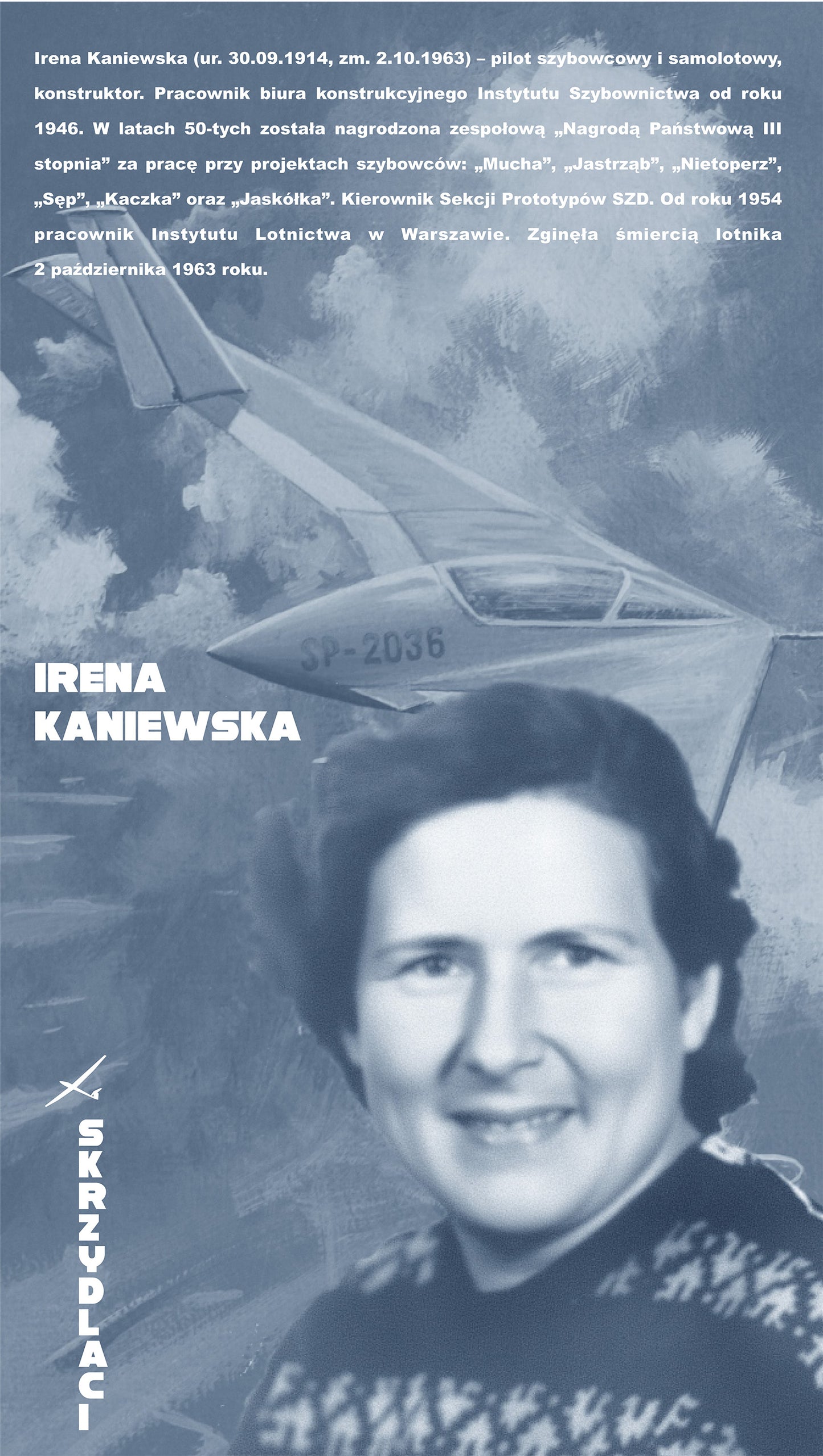
Irena Kaniewska
Irena Kaniewska
She was born on November 30, 1914, in Kraków, the daughter of Wilhelm Bronisław Kahl, a judge of the Supreme Administrative Tribunal of the Second Polish Republic, and Zofia née Wątróbska. In her youth, she built model airplanes and gliders, participating in the LOPP Capital District model flying competitions. In 1933, she passed her final exams at the J. Kowalczyk High School in Warsaw and began studies at the Faculty of Mechanical Engineering of the Warsaw University of Technology.
In 1938, she obtained her A and B glider pilot certification. From December 1940, she worked at the State Spirits Monopoly in Warsaw, continuing her studies at clandestine courses. In 1941, she graduated with a mechanical engineering diploma. She married engineer Feliks Kaniewski, who died in 1945 in the Buchenwald concentration camp.
After the war, she worked at the PMS in Żyrardów, and then at the PMS design office in Warsaw. She completed glider and airplane courses, obtaining a tourist pilot license. From 1946, she was a member of the Bielsko Aeroclub.
From 1946, she worked at the Gliding Institute in Bielsko-Biała (later the Glider Experimental Station), where she co-designed the IS-2 Mucha, IS-5 Kaczka, IS-7 Osa, SZD-9 Bocian, SZD-10 Czapla, SZD-13X Wampir, SZD-20X Wampir 2, IS-4 Jastrząb, and SZD-8 Jaskółka gliders. In 1952, she received a third-degree state award for the designs of the Mucha and Kaczka gliders. In 1954, she became head of the Prototype Section at SZD.
From 1954, she worked at the Institute of Aviation in Warsaw, designing glider targets, analyzing glider strength and dynamics, and developing regulations for the construction of aviation equipment. She led static tests of the TS-8 Bies aircraft and research programs for prototype aircraft and gliders.
In 1956, she won third prize for the Wróbel glider design. From 1957, she became an assistant professor and, from 1963, an independent researcher. She served as an aviation expert and a member of the Comecon expert commission.
She held the Silver Glider Badge (No. 287), the Gold Glider Badge with two diamonds, and certificates as a First Class Airplane Pilot, Second Class Airplane Instructor, First Class Glider Pilot, and Second Class Glider Instructor. She participated in aviation competitions, including the Polish Airplane Championships in 1959 and 1960.
She was the first woman in Poland to perform an inverted loop in an airplane. At the Warsaw Aeroclub, she trained 20 aircraft designers to become pilots. She was a member of the Aviation Examination Board of the Ministry of Communications and the glider and airplane competition boards.
She tragically died on October 2, 1963, in a plane crash on a CSS-13 aircraft, along with Andrzej Zasadziński, at Warsaw-Gocław Airport. She was posthumously awarded the Knight's Cross of the Order of Polonia Restituta. She is buried in the cemetery in Żyrardów.
Trivia:
Aviation pioneer
- She was the first woman in Poland to perform an inverted loop in an airplane – an acrobatic maneuver requiring great skill and courage.
- Glider constructor
- She co-created many innovative glider designs, including the IS-5 Kaczka – a glider with a "duck" configuration and a front tail, which was an unusual aerodynamic solution.
- She took part in the design of the first Polish glider with a laminar wing profile – the IS-7 Osa.
Awards and achievements
- In 1952 she received a state award of the third degree for the construction of the Mucha and Kaczka gliders.
- She earned the Gold Gliding Badge with two diamonds, which demonstrates her high level of piloting skills.
Mentor and examiner
- At the Warsaw Aeroclub she trained 20 aircraft designers to become pilots.
- She was a member of the Aviation Examination Commission of the Ministry of Communications and the commission for glider and airplane competitions.
Education despite the war
- During the occupation, she continued her studies at secret courses at the Warsaw University of Technology, obtaining a mechanical engineering diploma in 1941.
Clandestine activities
- During World War II, she was a member of the Home Army, worked in a vodka bottling plant and performed sabotage tasks.
- She took part in the Warsaw Uprising as a liaison, passing through the sewers to Żoliborz.
Tragic death
- She died an aviator's death on October 2, 1963, in the crash of the CSS-13 aircraft during a night flight at Warsaw-Gocław airport.