

Skrzydlaci
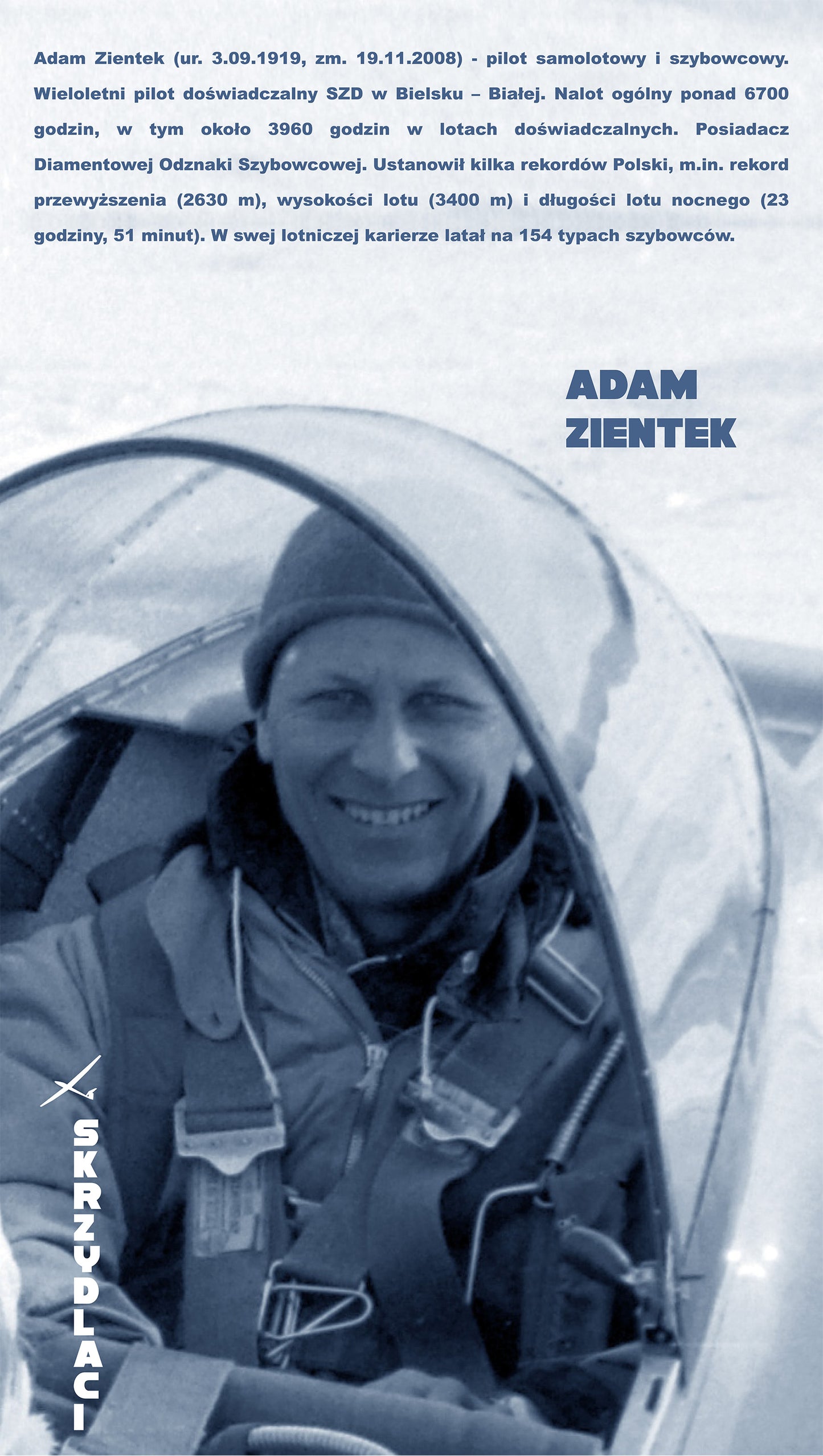
Adam Zientek
Adam Zientek
He was born on September 3, 1919, in Olbrachcice in the Zaolzie region, where his father, Adam (d. 1921), was the headmaster of a Polish school, and his mother, Zofia née Kożusznik, was a teacher. He spent his childhood in Ligotka Kameralna, near Śmiłowice in the Zaolzie region, which had been the Zientek family home since the 16th century. Little Adam's "technical kindergarten" was the neighboring 100-year-old wheelwright's workshop of Paweł Sabela. From 1925 to 1929, he attended a four-grade Polish elementary school in Ligotka Kameralna, and then an eight-grade State Mathematics and Natural Sciences Gymnasium in Cieszyn, where Julian Przyboś was the Polish language teacher.
In 1932, he escorted the funeral procession of Franciszek Żwirko and Stanisław Wigura, who died in nearby Cierlicko, from the border bridge over the Olza River. He had been interested in aviation since childhood. He built kites and glider models. In 1934, after strenuous efforts, at the age of 14 he was accepted into glider training run by the "Start" Glider Club in Cieszyn. In Gułdowy near Cieszyn, under the supervision of instructor Ludwik Puzoń, without medical examinations, shunts, or exercises on a wobbler, he made his first flight in a training glider "Wrona" SP-152, lasting 11 seconds. The flight proved to be a prelude to his future work as a test pilot, because, with the student weighing 45 kg, the glider had a too rearward center of gravity and was unstable, but the landing was successful without damage. In the same year, during the first course of the Gliding School of the Silesian Aeroclub on the slopes of Chełm near Goleszów, under the supervision of instructor Antoni Pawliczek, he obtained the A and B categories of glider pilot. In 1935, he flew in Bezmiechowa under the supervision of instructors Piotr Mynarski and Michał Offierski, and in August, flying "Czajka", he obtained the C category of glider pilot no. 187 in Poland. The following year, he continued flying in Bezmiechowa under the supervision of instructors Adam Dziurzyński and Ryszard Dyrgałło, flying "Sroka", "Komar" and CW-5, and obtained the first two conditions for Category D (Silver Glider Badge): 5 hours of flight time and 1000 m of vertical drop.
In 1937, he passed his secondary school leaving examination. He completed a towing and aerobatics course in Katowice under instructor M. Offierski. He participated in a double-towing demonstration of two "Komars" behind an RWD-8 aircraft. He completed a flight of 83 kilometers and obtained Category D, number 78 in Poland and number 589 in the ISTUS register. His participation in the 5th National Gliding Competition in the "Komar bis" did not take place when, on site in Inowrocław, it was determined that the pilot was under 18 years of age. In the fall, he began his studies at the Faculty of Mechanical Engineering of the Warsaw University of Technology and continued them until the outbreak of the war. He was a member of the Aviation Section of the Mechanical Students' Association of the Warsaw University of Technology. Covering the costs of his education and flying was not possible without the significant help of his cousin Stanisław Zientek and his older siblings, Alfred and Zofia.
In 1938, he participated in the 6th National Gliding Competition in Masłów and took 16th place out of 36 participants in the "Orlik" glider. After Zaolzie was incorporated into Poland, he obtained Polish citizenship. In August 1939, he completed flight training on the RWD-8 as part of the Military Training (PW) program at the Rumia airport near Gdynia, which he completed a few days before the outbreak of the war. Mobilization found him on his way back in Kraków, where he reported for duty at the 2nd Air Regiment in Rakowice, but was sent home. With the wave of civilian escapes from Cieszyn, he reached Lviv, from where, after the Soviet army entered, he made his way back to the German-occupied part of Poland. During the war, he worked as a worker in a screw factory in Frysztat near Cieszyn. After liberation, he moved to the Polish side of the restored border on the Olza River.
After a 5-year war break, in 1945 he made his first 15-minute sailing flight over the slope of Chełm in a salvaged "Salamandra" and flights in Jeżów. In 1946 he resumed his interrupted studies at the Polytechnic Faculty of the Mining Academy in Kraków, joined the Aviation Section and enrolled in journalism. He flew in Balice, Błonia, Bielsko, where he obtained the qualifications of a 1st class glider instructor, Żary and Jeżów. He engaged in pioneering research in Poland into the possibilities of wave flights and the issue of optimal jump speeds. On October 21, 1946, in Bielsko, while flying on a wave, he was forced to make his first rescue jump. In the glider "Orlik I" with a reverse turn indicator, he found himself in clouds and the glider disintegrated in a steep spiral.
In 1947, he completed a 355 km flight from Balice in the glider "Ważka". He also took part abroad for the first time in the Internationals Segelflugwoche in Samec, Switzerland, in the new Polish glider "Sęp", and took 1st place out of 21 competitors. On November 1 of that year, he began working as a glider test pilot at the Gliding Institute in Bielsko. In March 1948, in the "Sęp", he attempted to break the flight endurance record and crashed at night in the lee of Żar due to the extinguishing of the signal fire. In June, in the "Sęp", in the 7th National Gliding Competition in Żar, he took 1st place out of 24 competitors. On July 27, 1948, with almost no wind and a southerly sky strewn with cumulus clouds, four glider pilots decided to fly as a group from Żary to Prague. The group consisted of the prototype "Fuch" with Irena Kempówna at the controls, two "Sęp" gliders piloted by Adam Zientek and Edward Adamski, and the "Olimpia" glider piloted by Władysław Dziergas. The route led over Zaolzie, where, by a stroke of luck, Adam Zientek's "Sęp" glider was spotted by his family in Śmiłowice, causing quite a stir. Because the cumulus clouds ended halfway towards Prague, the team unanimously, although without communication or maps, took the direction of Vienna. Cumulonimbus clouds that appeared along the route near the Austrian border caused the team to disperse. A. Zientek landed at the foot of the Alps at the Soviet airfield in Wiener Neustadt (the distance flown was 309 km, the elevation gain was 3,413 m), E. Adamski and Kempówna near Vienna, and Wł. Dziergas in Czechoslovakia. It is difficult to describe the commotion that followed. In any case, the participants of the "expedition" received two letters back home: one from the Ministry of Communications with a severe reprimand for a "bunch" of offenses, and the other with the signature of the same person, but on the form of the Aeroklub Rzeczypospolitej (Aerial Club of the Republic of Poland), congratulating them on their extraordinary achievement.
The year 1948 was also noted for obtaining Poland's second Golden Gliding Badge and national records in a two-seater glider. On October 18/19, 1948, in Żary, in the "Żuraw" glider, Adam Zientek and his passenger Bronisław Żurakowski set a national flight endurance record of 23 hours 51 minutes. In the same glider, he set a national altitude record in the two-seater glider category with a result of 2,320 m. In June 1949, during the International Gliding Competition of the People's Democratic States held in Żary, A. Zientek, flying the "Sęp", took 2nd place out of 19 participants. In the same year, he set the first national speed record on a 100 km triangle route with a result of 29.7 km/h. In total, he set 6 different national gliding records.
Gradually, however, the increasing professional responsibilities of a test pilot limited his participation in sports and competition flying to isolated occasions. For example, in 1951, during the 8th KZS in Inowrocław, he flew the prototype of the "Osa" glider outside of competition, for experimental purposes. As early as 1955, he completed the Diamond Gliding Badge in the "Jaskółka" with a 590 km flight from Lisie Kąty, during which he crossed the border undetected, flew over Kaunas and Vilnius, and landed near Bracław on the border of Soviet Latvia. The final highlight was his participation in the Jeżów-Olsztyn-Jeżów Gliding Rally Around Poland in July 1961 in the "Jaskółka" (1st place). From then on, A. Zientek's further achievements focused mainly on testing new gliders and related activities such as acquisition and training. And there was an exceptionally large number of these.
Adam Zientek worked as a glider test pilot for 35 years (until April 21, 1983), never changing jobs, although the job itself changed names several times. Due to strict health requirements in Poland, he worked for the next five years not as a pilot, but as a flight test observer.
He considered the first twenty years to be the most interesting and enjoyable, a period he called "building from nothing," developing test methods, equipment, and documentation methods. His feel for the air, the ability to "listen" to the glider in flight, and a common language with the designers allowed him to familiarize himself with subsequent prototypes, and the flight instructions that crowned his work were a model of concise, clear communication.
He was particularly impressed by the tests of unorthodox gliders, i.e. tailless and duck-shaped. The tailless "Nietoperz" (12 January 1951), immediately after the programmed release after take-off, while still in the tow, suddenly fell and hit the ground, crushing the front of the fuselage. The tailless "Wampir" (6 October 1959), after exceeding a speed of 140 km/h for the first time, demonstrated a violent flutter with rapidly changing accelerations, as a result of which the glider lost its wings and the pilot suffered a momentary loss of function and consciousness. Fortunately, simply unfastening the seat belts was enough for the pilot to fall from the cockpit as if from a catapult. His life was saved by his flight helmet, which left a trace of paint from the impact of the torn wing. The parachute did not protect him from vertebral and kidney injuries.
Unfortunately, some orthodox designs also provided strong experiences. During a diving test on "Zefir 3" (23 February 1966) at a speed of 272 km/h, a flutter occurred, this time without any acceleration in the cabin, as a result of which the wing and tailplane of the glider disintegrated. The pilot described the exit from the cabin as comfortable.
Difficult situations occurred not only during experimental flights. During transport, while towing the Czech "Blanik" from Bielsko to Warsaw at Gocław (December 30, 1963), the team was cut off from the ground by 600-meter-thick stratus clouds. The glider had no radio and the turn indicator was inoperative, a fact unknown to the towman. During the team's unsuccessful attempt to descend below the ceiling, the glider's canopy became icy, leaving the pilot with only visual contact with the plane through the side window. Stanisław Skrzydlewski in the "Gawron" (Gawron), via telephone from the tower, established contact with the crew of the precisely installed PAR approach radar at Okęcie, which enabled the "blind" and "deaf" glider to land in an emergency under tow behind the plane in IFR conditions – a fact probably unprecedented in the world.
As with most test pilots working in the aviation industry, his testing activities were supplemented by participation in numerous air shows and acquisition events. The list of countries and aviation events where A. Zientek demonstrated his company's designs covers virtually all of Europe and all the major events, many of which he attended multiple times. Adam's competence, ease of communication, and engaging manner complemented the qualities of the Polish gliders.
A natural consequence of his acquisition activities was sales, equipment supply, and customer training. This latter activity significantly extended his flying career after he lost his national license. Taking advantage of the fact that health requirements in most European countries were less stringent, he continued to travel annually to various countries for many years to provide flight training—not basic training, incidentally, but rather training in glider acrobatics and cloud flying, contributing to the improvement of glider pilots there. In total, he trained approximately 200 acrobats in Austria, Denmark, Finland, Germany, Norway, Sweden, and Italy.
He was often accompanied on his flying expeditions by his wife, children, and grandchildren. Back home, as part of the "Bekasa" flight tests, he taught a group of SZD Bielsko employees to fly, and many others fondly remember passenger flights with the tireless Mr. Adam and his habit of whistling melodiously during the flight. He enjoyed flying in Żary, where in 2001 he made his last flight in the "Puchacz." At that time, he was one of the last active glider pilots from the pre-war generation.
This passion for flying resulted in an exceptional accumulation of aviation practice and experience. Between 1934 and 2001, he completed over 12,800 glider flights, totaling over 6,700 hours, including 3,960 hours of test flights and over 1,430 hours as an instructor. He completed 1,700 flights in 15 aircraft types, totaling 530 hours. During this time, he flew 154 glider types, including four tailless gliders and one canard. In addition to the aforementioned flights of 33 prototypes and their tests, he completed approximately 1,200 flights of gliders built in series or repaired in Bielsko, Jeżów, Krosno, Poznań, and Gdańsk. He saved himself three times by parachute. He acted as a double of a glider pilot in the film "Pierwszy start" by Leonard Buczkowski (1950), piloted the prototype of "Pirat" and "Foka 4" in the film etude "Chmury" by Sergiusz Sprudin (1966) and took part in the production of the film "Polskie gliderowce" by S. Sprudin (1966).
In the aviation world, Adam Zientek was an exceptionally modest man, yet very popular, respected, and well-liked. His affection was expressed through witty diplomas from colleagues on the occasion of his aviation anniversaries, illustrated with caricatures by Bogumił Szuba and punctuated with poetry by Wiesław Stafiej, as well as honorary membership in numerous aeroclubs across Europe. He was adept at conveying his experiences, experiences, and observations to others through articles in the national and international press, as well as through larger works, such as his memoirs "The Great Adventure," published in 1955; the textbook "On the Halnian Waves," published twice in 1951 and 1956; and papers presented at international conferences, including "Polish Experiences in Flights on Tailless Gliders" (OSTIV).
In the 1950s, he was Chairman of the Sports Committee of the Polish People's Republic Aeroclub. He assisted in editing sports bulletins during the Gliding Championships in Leszno. He was Chairman of the Bielsko-Biała Aeroclub Peer Court, Vice-President of the Bielsko-Biała Senior Aviation Club, and a member of the Test Pilots' Club. He received numerous distinctions and awards for his work. Among them were the Knight's Cross of the Polish Air Force (OOP) (1983), the Golden Badge of Merit for the Polish Air Force (AP), the P. Tissandier FAI Diploma (1962), the Blue Wings, the Honorary Diploma of the NOT W-Master of Technology (1972) for the Foka glider, the NOT Team Award, 1st Degree (1982) for the Puchacz glider, and the Golden Test Pilot Badge. He held the Golden Caterpillar Badge awarded to pilots who saved their lives using an "Irvin" parachute.
In 1949, he married Jadwiga Studencka, secretary of the Gliding School in Jeżów, sister of instructor and air traffic pilot Tadeusz Studencki, whom he met in Jeżów during a wave expedition. For 60 years, they lived near the Slavic stronghold in Stare Bielsko. The family's interest in aviation continued, as their son, Stanisław (1950), is an aviation engineer and designer of the "Junior" and "Brawo" gliders, a three-time Polish gliding champion pilot, and a multiple World Championship participant. Their daughter, Danuta (1951), graduated in economics and ran a clothing company. Their daughter, Mirosława (1957), a speleologist, diver, and ocean sailor, earned two qualifications for the Silver Gliding Badge and was a parachute jumper. His grandson Wiktor Adam (1990), son of Stanisław, also underwent glider training.
He spent his retirement busily, among other things, acquiring and coordinating paintwork and inspections of gliders from all over Europe, carried out in workshops around Bielsko-Biała, and over a hundred of them passed through his hands. For several decades, he was a translator of NOT technical texts into German, Czech, and Slovak. Together with his wife, he passionately tended the orchard and garden he had planted in Jaworze near Bielsko, and devoted much time to his grandchildren. He regularly engaged in morning exercise and went hiking. He was impressed by Richard Bach's book "The Seagull." Besides aviation, his hobby was researching the historical issues surrounding the Czech annexation of Zaolzie in 1919 and 1945. A week before his passing, he traveled back to his roots, visiting his family home in Śmiłowice, his former apartment, and the old wheelwright's workshop (now an open-air museum) in Ligotka Kameralna "Żwirkowisko" in Těrlicko. Cieszyn former glider on Mount Chełm.
He died on November 19, 2008, at the age of 90. He was buried in the Protestant cemetery in Stare Bielsko, in the shadow of the 200-year-old Church of St. John the Baptist, whose architect and builder were his maternal ancestors.